What is Personalism?
To answer the title question, What is personalism?, we must first ask, What is it that makes the human person so significant?, for only if we have something of an answer to this question do we have any justification for exploring personalism as a movement of contemporary thought. Yet, even before we begin to answer this latter question, we must first take note that in our ordinary everyday experience we already discover the human person to be the preeminent feature of the world. This is the first and most important thing to acknowledge at the outset, for without such an acknowledgment we might make the mistake of holding personalism merely as a philosophical theory, and not also as a philosophy of life—and indeed, a philosophy for life.
This basic recognition of the importance of persons is most patent with respect to ourselves and our loved ones, especially our family and friends, yet it is also possibly (and ideally) the case with respect to all other persons we meet in the daily course of our lives, with the postman, janitor, and storekeeper alike. Indeed, I would argue that everyone has this basic intuition always already embedded in their experience, and moreover, that this feature of experience ordinarily coordinates the remainder of our experiencing, both of the world and its many kinds of things, and of our place in the world together with these things. Another way of stating all this is to say that among the many things and kinds of things we encounter in the course of our everyday lives, the human person naturally stands-out more forcefully than anything else, and it does so in such a way that the person ordinarily distinguishes itself as the most important object of our experience.
Thus, the person and what is personal is the natural focal point of our lives; and every encounter is potentially a properly personal encounter.
This basic human intuition is then keenly captured by the late medieval philosopher-theologian, St. Thomas Aquinas, when he explains that the term ‘person’ has been crafted in human history in order to ‘signify what is most perfect in all nature.’ A little earlier in the same section of his Summa theologiae, Aquinas provides something of a justification for this claim, there saying that in ‘a more special and perfect way, the particular and individual is found in rational substances [namely, persons], who possess dominion over their own actions.’ Thus, with an exceptional brevity of expression and with perfect precision, Aquinas clarifies the place of the human being within the natural created order, and thereby brings to rational clarity this most foundational human intuition, while also providing the grounding reason why this is so in the rational and free nature of the human person. Though we will later see that this is not the only basis for the significance of persons, we can already here grant that this dominion over action is the nexus through which everything properly personal passes. Accordingly, with words borrowed from Gottfried Leibniz, though differently attributed, we can with Karol Wojtyla (later Pope St. John Paul II) affirm that the human person is an ‘ens perfectissimum (a perfect being).’
Now, of course, this does not mean that any living human person is actually morally perfect, at least in this life. I am certainly not, and I would venture that you too are not. Yet, despite our evident moral shortcomings—our frailty, weakness, and sinfulness—as is clearly manifest in the fact that we do not yet possess the perfection of virtue, we can already recognize that precisely as beings that bear the personal nature, we nonetheless possess this basic perfection in being. Thus, technically speaking, though we are not morally perfect, we are nonetheless ontologically perfect (derivative of the Ancient Greek for being, ‘on (ὄν)’).
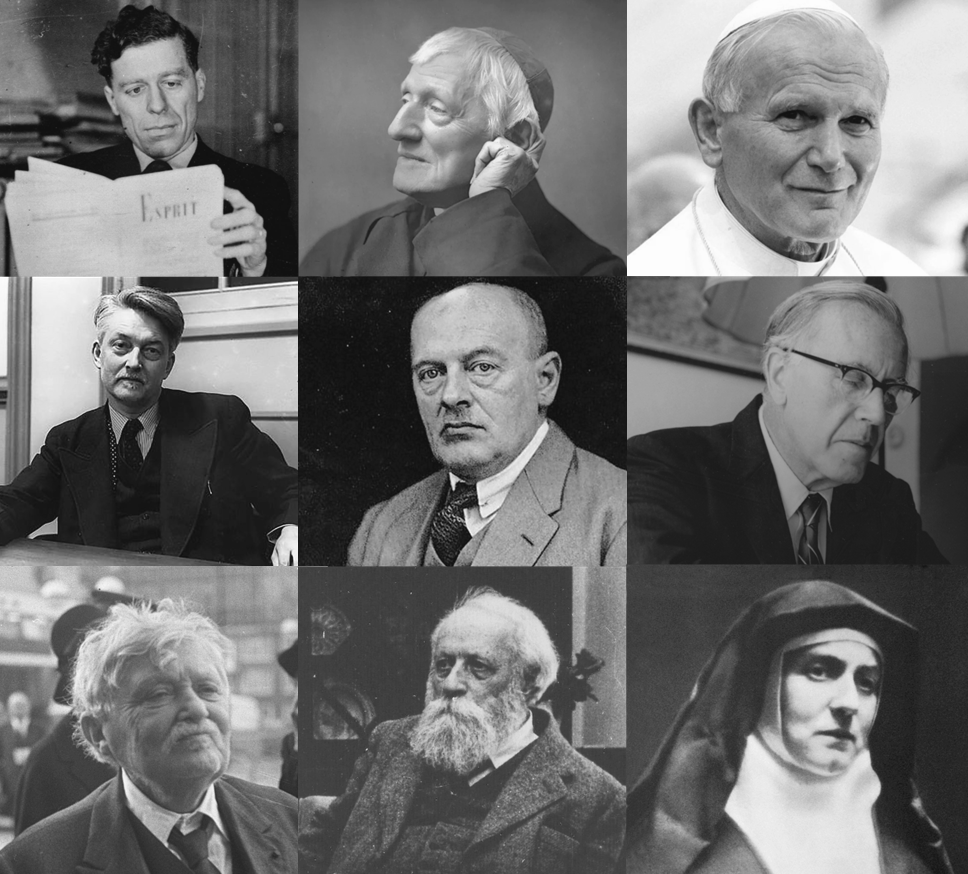
In these interconnected insights of Aquinas, we already find something like the seedbed of philosophical personalism (as well as theological and legal personalisms), even while personalism itself becomes a leading movement of thought only much later in the history of the Western intellectual tradition—with, among others, thinkers like Karol Wojtyła, Edith Stein, and Dietrich von Hildebrand. These contemporary thinkers have achieved something new, for sure; and yet they have also reaped from the seedbed sown by Aquinas and other Medieval thinkers (such as Sts. Augustine, Boethius, and Bonaventure), who themselves have reaped from the thought of the Ancient Greek masters (such as Socrates, Plato, and Aristotle). This earlier thought is genuinely pregnant with an immense density of meaning, and these later thinkers have borne much fruit latent in this earlier crop, but not yet signaled in its importance or expanded in its import.
Thus, even while the predominant duration of the philosophia perennis (perennial philosophy) is not properly speaking ‘personalist,’ at least in the sense generally granted the term, it does provide several personalist strands of thought, together with furnishing the remote origins of several more personalist strands of thought, while also preparing the soil for later thinkers to take up the task of unfolding this tradition in its proper personalist proportions.
But what exactly is personalism?
Personalism is quiet difficult to define with precision, largely because it exists in many variations, Christian and non-Christian alike, while also spanning many different intellectual disciplines and subdisciplines, those philosophical, theological, and legal, to mention but a few. Nonetheless, one feature appears to unite personalism across its many variants, namely, the priority of the person and what is personal. All truly personalist strands of thought place the human person at the center of their considerations, and all hold to the primacy of the person in their respective fields of investigation, whether those explorations be foundationally metaphysical, ethical, or epistemological in nature. Moreover, something highlighted by nearly all strands of personalist thought is the centrality of personal subjectivity together with the significance of conscious experience. Hence, a most helpful entry-point into a personalist way of thinking is found in paying attention to subjectivity, since subjectivity brings us right to the heart of the mystery of being a person, while firmly placing the person at the center of our considerations.
The reason for this subjective emphasis arises out of the fact that subjectivity is, so to speak, the most vivid place of encounter with the person as such, so that an appreciation of personal subjectivity provides the fitting window for unveiling the mystery of personal life, and a most suitable entry-point into a characteristically personalist way of thinking. Thus, in what is now a famous quotation, Wojtyła will say,
The experience of man cannot be exhausted by means of ‘cosmological’ reduction. We must consider l’irréductible [the irreducible], what in every man is unique and unrepeatable, through which he is not only ‘in particular’ this man—an individual of a species—but through which he is a person: a subject. Only then is the image of man correct and complete.
The ‘cosmological reduction’ here mentioned is a way of thinking about the human being in terms of its place in the cosmos, where the human is classified as one natural species among a plurality of species and specified as a ‘rational animal.’ Now, however helpful this manner of classification, such an understanding of the human does not yet get us to a proper understanding of the characteristically human. We need to look more closely. We need to complement the cosmological focus on objectivity with a similarly weighted focus on subjectivity. Consequently, Wojtyła urges us to ‘pause at’ or ‘dwell upon’ the irreducible of subjectivity, for ‘only then,’ he argues, can we begin to understand what it means to be a human person.
In future posts, I will have much to say about this irreducibility of the person, both in terms of the irreducibility of personal subjectivity, and in terms of the consequent irreducibility of the person as such (as well as dealing with several additional bases of irreducibility), here we can already say that a foundational kind of personal irreducibility is to be found in the fact that subjectivity is something fundamental in the strongest possible sense. Evidently, when we honestly approach subjectivity, we discover that there is no perspective more fundamental than subjectivity, since there is no actual (or even possible) vantage-point beyond subjectivity by which it could be viewed, understood, and grasped. There is, therefore, no ‘element’ underneath or behind personal subjectivity to which it can be reduced and by which it could be explained.
Of course, such attention to subjectivity, as I have given it here, should not lead to ignorance of the substantiality of the person, and nor should it in any way encourage the sidelining of the objectivity that brings with it an appreciation of the person as something subsistent. Yet, on the other hand, the earlier objectivity that brings the substantiality of the person before us should not lead to any disregard for the central significance of personal subjectivity, especially in its perspectival irreducibility. Rather, in contrast to positioning ourselves at one or other pole of the problem, we must pay attention to the objective and the subjective poles of experience in tandem with one another—as they are naturally arrayed with respect to one another. And we must therefore also pay due attention to to the cosmological and the experiential together with one another (and that is to the metaphysical and the phenomenological), if we are to truly appreciate what it means to be a person.
The attention personalists have given to subjectivity can then be seen as a refocusing of our collective understanding upon a particular sine qua non of being a person, namely: the fact that every personal individual is a center of consciousness, facing the world in an aware and self-aware manner; and moreover, the fact that every personal individual (suitably matured) is a center of knowing and loving, intelligent and free, determining his or her place in the world through his own de actions. This is the grandeur of being a person, that each of us is a true center of conscious being and intelligent life, and it is something wonderful. Accordingly, over the course of the coming posts, through an analysis of the subjectivity of the person together with its substantiality, we will enhance our understanding of what it means to be a person, and thus attain something like an adequate appreciation of the value of the personal individual.
Notes: Thomas Aquinas, Summa theologiae I.29; Karol Wojtyla, ‘Subjectivity and the Irreducible in Man,’ in Person and Act, p. 542.
